How to Plan a Kids’ Birthday Party: The Step-by-Step Guide
The birthdays that come together beautifully aren’t necessarily the ones with the most décor or the longest entertainment programme. They’re the ones where every element belongs to the same celebration.
Planning a children’s birthday can look deceptively simple: choose a theme, order balloons, arrange food and find some entertainment.
In practice, the birthdays that come together beautifully aren’t necessarily the ones with the most décor or the longest entertainment programme. They’re the ones where every element belongs to the same celebration.
At Kids Hub, we start with the child and build outward: the theme, invitation, colour palette, décor, tables, food, activities, entertainment and, finally, the flow of the day.
After organising many children’s birthdays at our venue in Dubai Marina, we’ve learned that the small decisions are often the ones that make the biggest difference.
This is the process we use — and the same process you can follow whether you’re planning your child’s birthday yourself or choosing a venue and team to bring everything together for you.
1. Start with the child — not the decorations
Before choosing balloons or ordering a cake, decide what kind of birthday you’re actually creating.
Start with six things:
- Your child’s age
- Their current interests
- The number and ages of guests
- The birthday theme
- The overall feeling you want
- Three to five core colours
The child’s age matters just as much as the theme.
A birthday for two-year-olds needs a very different rhythm from a birthday for seven-year-olds. Younger children usually benefit from more free play, sensory experiences and shorter organised activities. Older children can usually stay engaged for longer with structured games, workshops and challenges.
The same applies to the theme. Instead of starting with “What decorations should I buy?”, start with “What is my child really interested in right now?”
It could be space, animals, construction, a favourite game or character, princesses, dinosaurs, cars, art or something completely specific to your child.
Once that direction is clear, every decision that follows becomes easier.
Kids Hub tip: Don’t start buying individual decorations before you’ve decided on the overall concept and colour palette. That’s one of the easiest ways for a party to end up looking disconnected.
2. Let the invitation introduce the birthday
The birthday experience doesn’t begin when guests walk through the door.
For most families, it begins with the invitation.
We design the e-invite after the theme has been selected so it becomes the first part of the birthday’s visual identity.
At minimum, your invitation should include:
- Child’s name
- Age
- Date
- Start and finish time
- Venue
- Location
- RSVP details
- Any important instructions for guests
But don’t think only about the information.
Think about the design too.
If you’re planning a space birthday using navy, sky blue, white and silver, those colours can already appear in the invitation. If you’re creating a bright character birthday, the invitation can introduce that visual world before guests ever see the venue.
Think of the invitation as the first piece of décor your guests see.
It doesn’t need to reveal everything. It simply needs to establish the birthday’s visual direction.
3. Build a balloon palette — not just a balloon colour
One of the questions we hear frequently when planning décor is:
“What colour balloons should we use?”
We don’t usually think about balloons as a single colour.
We build a balloon palette.
Choosing a balloon palette is different from deciding that a party will be “blue” or “pink”. Even several shades of the same colour won’t necessarily create the depth you see in a professionally styled balloon installation.
We normally think about the palette in four layers.
1. Dominant colour
This is the colour your eye notices first and usually the colour that connects most strongly to the overall theme.
2. Supporting colours
One or two additional colours help build the visual story around the dominant shade.
They should complement it rather than compete with it.
3. Contrast colour
A darker, lighter or complementary shade creates separation and prevents the installation from looking flat.
4. Accent or finish
This might be metallic silver, chrome, transparent balloons, confetti balloons or another finish used in smaller quantities.
The accent doesn’t need to dominate the installation. Its job is to add dimension.
And colour is only half of the equation.
Balloon size matters too.
A professional-looking balloon arrangement normally uses several sizes.
Large balloons establish the overall shape.
Medium balloons create the main body of the installation.
Small balloons and clusters fill transitions and create the organic, dimensional finish.
Using every balloon at exactly the same size tends to make an arrangement look much flatter.
Two real Kids Hub birthdays, two completely different palettes
Space Crew birthday
Look at the first birthday.
The backdrop itself is dark and space-inspired. If we had simply surrounded it with dark balloons, the entire setup would have become visually heavy.
Instead, the balloon palette combines:
- Dark navy / black — the anchor
- Red — connecting directly to the characters
- Yellow / orange — warmth and contrast
- Transparent balloons — lightness and dimension
But the palette doesn’t stop at the balloon installation.
Look at the children’s table.
The same visual world continues through the table covering, plates, cups, napkins, centrepieces and individual helium balloons.
That’s what makes the setup feel coordinated rather than decorated in separate pieces.
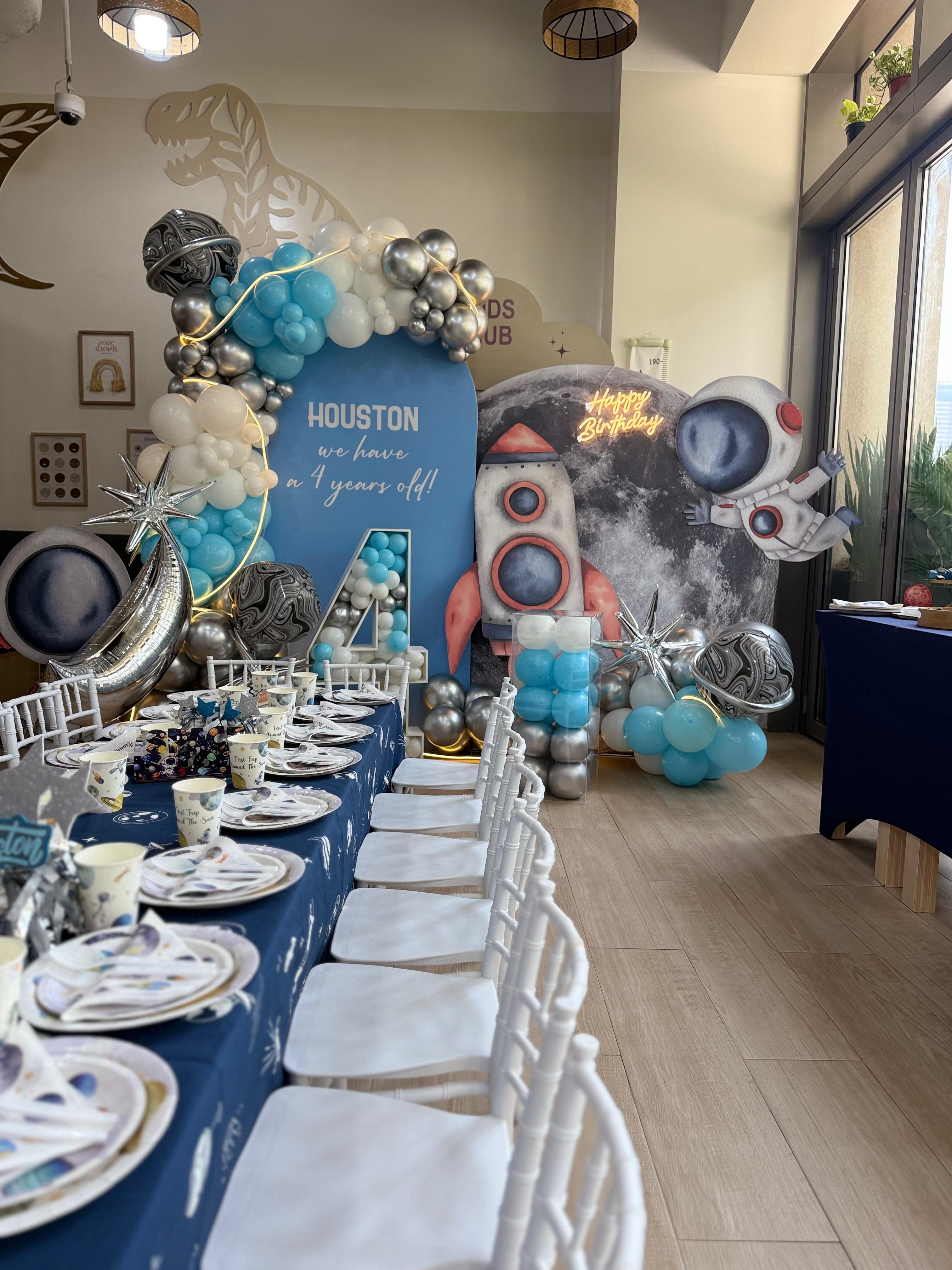
Space birthday
Now look at the second setup.
It is also a space theme, but the visual direction is completely different.
Here we use:
- Navy blue — the visual anchor
- Sky blue — the main supporting colour
- White — to soften the composition
- Metallic silver — the accent and finish
Silver appears in the planets, stars, props and selected balloons, but it isn’t used everywhere.
That’s important.
An accent colour works because it is an accent.
The result is a softer, more dimensional interpretation of a space birthday while still making the theme immediately recognisable.
The principle to remember
THEME → COLOUR PALETTE → BALLOON PALETTE → DÉCOR → TABLE
Try not to choose these elements independently.
When colours repeat intentionally from one element to another, even a relatively simple birthday starts to feel professionally put together.
4. Build one strong birthday focal point
Once the visual direction and palette are decided, we start building the main focal point.
This is usually the area guests notice first and the area that appears in the most photographs.
Depending on the birthday, it may include:
- Main backdrop
- Child’s name
- Child’s age
- Themed artwork
- Balloon installation
- Props
- Cake plinths
- Cake
- Lighting or signage
- Character or theme elements
One of the most common decorating mistakes is trying to decorate every available wall and corner.
You don’t need to.
Look again at our Space birthday.
There are several elements in the main composition: the personalised panel, moon backdrop, rocket, astronaut, age marker, dimensional planets, balloons and metallic details.
There is a lot happening, but it’s concentrated in one visual area.
The rest of the room has space to breathe.
A strong focal point also gives the birthday a natural location for the cake ceremony, family photographs and group pictures.
More decoration isn’t automatically better decoration. A strong focal point is usually more effective than spreading smaller decorations throughout the entire room.
5. Carry the theme onto the children’s table
The children’s table shouldn’t feel like something that was added after the décor was finished.
It’s part of the same birthday.
Once we’ve established the theme and colour palette, we can repeat selected elements through:
- Table covering
- Placemats
- Plates
- Cups
- Napkins
- Cutlery
- Centrepieces
- Water
- Small themed details
Look again at the Space Crew birthday.
The table clearly belongs to the same celebration as the backdrop, but it hasn’t been filled with oversized decorative pieces.
That’s intentional.
Children still need to be able to sit comfortably, reach their food and drinks, talk to one another and actually use the table.
A tall centrepiece may look beautiful in a photograph, but if the child opposite can’t see their friend, it isn’t doing its job.
Our rule is simple:
Style the table for the photograph, but set it up for the child.
Avoid anything too tall, unstable, fragile or large enough to take over the child’s eating space.
Beautiful and functional aren’t opposites. A good children’s table should be both.
6. Remember you’re actually hosting two groups
A children’s birthday usually has two groups of guests:
the children and the adults.
It’s surprisingly easy to plan every detail for 15 children and then realise that 20 parents have nowhere comfortable to sit.
For the children, consider:
- Child-sized tables and chairs
- Meals
- Water and drinks
- Activities
- Entertainment
- Play
- Cake
For the adults, consider:
- Comfortable seating
- Tables where appropriate
- Water and soft drinks
- Coffee and tea
- Food or light bites, depending on the party format
This becomes especially important for toddler and preschool birthdays, where parents are more likely to remain throughout the celebration.
So when you’re confirming the guest list, don’t ask only:
“How many children are coming?”
Also ask:
“Approximately how many adults will stay?”
That one number can change your furniture, food and space planning significantly.
7. Plan food around the party flow
Children’s birthday food doesn’t need to be complicated.
What matters more is that it is:
familiar, age-appropriate, easy to portion, easy to eat and served at the right time.
When planning the children’s menu, think practically.
Can the children eat it easily at the table? Will serving it take a long time? Is it appropriate for the age group? Have you checked for allergies or dietary requirements?
Then think separately about the adults.
If parents are staying for two or three hours, consider whether you need adult refreshments, coffee, tea, finger food or a separate adult food selection.
But there is another part of food planning that’s just as important as the menu:
When are you serving it?
Don’t schedule the children’s main meal immediately before the most energetic part of the entertainment programme.
Likewise, don’t interrupt an activity the children are completely absorbed in because the food happens to have arrived.
We use the food break as part of the rhythm of the party.
It gives children an opportunity to sit down, eat, drink and reset before the next shared moment.
Food isn’t separate from the programme. Its timing is part of the programme.
8. Build an entertainment programme — don’t collect entertainment
It’s tempting to think that more entertainment automatically means a better birthday.
Animator. Bubble show. Magic show. Mascot. Workshop. Face painting. Another show.
But the question we ask isn’t:
“How many things can we fit into the party?”
It’s:
“What should the children experience next?”
We find it useful to think about birthday entertainment in three broad groups.
Hands-on
These are activities where the child actively makes, touches, experiments or creates.
Depending on the birthday and age group, that can include:
- Messy play
- Slime making
- Gypsum painting
- Tote bag workshop
- Cookie decoration
- Pot decorating and painting
- Cup design
- Other creative activities
Hands-on activities create periods of concentration and participation.
Interactive
These are higher-energy experiences where children participate together.
They can include:
- Animator-led games
- Movement
- Dancing
- Group games
- Challenges
- Character interaction
Interactive activities raise the energy and help bring the group together.
Show
A show changes the dynamic again.
Depending on the programme, this may include:
- Magic show
- Bubble show
- Mini zoo
- Paper party
- Glow in the dark
- Other show programmes
Here, the children aren’t being asked to constantly do something. Their attention shifts towards a shared experience.
The professional trick is the sequence.
A programme like this:
SHOW → SHOW → SHOW → ANIMATOR → WORKSHOP → CAKE
may sound impressive on paper, but it doesn’t necessarily create a better experience for the children.
Instead, think about changing the pace:
ARRIVE & PLAY → INTERACTIVE → FOCUSED → BIG MOMENT → FOOD / RESET → CAKE
Children’s energy changes throughout a birthday.
The programme should change with it.
9. Match the programme to the children’s age
The right entertainment depends heavily on who is actually attending.
A programme that works beautifully for six-year-olds can completely lose a group of two-year-olds.
Toddlers
Prioritise movement, sensory experiences, music, bubbles, free exploration and short interactions.
At this age, flexibility matters. Children shouldn’t be expected to sit through long organised programmes.
Preschool children
You can begin introducing simple group games, messy play, characters, dancing and shorter shows.
Activities should still move relatively quickly and leave room for free play.
Early school age
Children can usually engage for longer with structured games, workshops, challenges and show programmes.
They can follow more instructions and often enjoy working towards a result.
Older children
Think about team games, challenges, creative projects and activities that give children something to master, complete or take home.
But age is only the starting point.
Group size, personalities and — most importantly — what the birthday child actually enjoys should influence the final programme.
10. Don’t programme every minute
Free play is not empty time.
It’s part of the birthday.
Children need time to:
ARRIVE → LOOK AROUND → FIND THEIR FRIENDS → EXPLORE → PLAY → RESET
When children first arrive, some immediately join the group. Others need time to observe the room, find someone they know and settle into the environment.
The same thing happens after a high-energy activity or show.
They may simply need a little time to play.
This is one of the advantages of holding a birthday in a dedicated children’s venue: play doesn’t have to be manufactured as another scheduled activity.
There is already an environment children can move into naturally between the organised parts of the celebration.
So don’t feel that every five minutes of the birthday needs a scheduled activity.
Sometimes the best thing on the programme is simply:
Play.
11. Plan the cake moment — not only the cake
Parents spend a lot of time choosing the birthday cake.
But the cake itself is only one part of the moment.
Of course, you need the practical things:
- Cake
- Candles
- Lighter
- Cake knife or server
- Plates
- Forks
- Napkins
Then ask the questions that are easy to forget:
- Who gathers the children?
- Who brings the cake?
- Who starts the birthday song?
- Where will the birthday child stand?
- Where will the parents stand?
- Is the photographer or person taking photographs ready?
The cake ceremony may last only a minute or two, but it is often one of the most photographed and remembered parts of the entire birthday.
Treat it like a moment, not simply the time when dessert is served.
12. Photograph the setup before anyone touches it
If you’ve spent time creating the backdrop, balloons, table settings, cake and personalised details, photograph them before the guests arrive.
Take your detail photographs while everything is still exactly where you placed it:
- Backdrop
- Balloon arrangement
- Children’s table
- Place settings
- Cake
- Personalised details
Because once the children arrive, the room changes very quickly.
Chairs move.
Cups appear.
Balloons get touched.
Napkins disappear.
And that’s completely fine.
That’s what the party is for.
Once guests arrive, stop trying to preserve the perfect setup and change what you’re photographing.
Capture the birthday child, their parents, friends, natural play, entertainment, reactions and the cake ceremony.
The photographs before the party document what you created.
The photographs during the party document why you created it.
13. Plan the goodbye
The end of the birthday deserves a little planning too.
If you’re giving children goody bags or party favours, keep them near the exit and distribute them when guests leave.
Giving them out halfway through the party often means children immediately want to open them, compare what’s inside or start playing with the contents while another activity is happening.
At the exit, the favour does exactly what it should do:
it becomes a small final thank you for coming.
It also gives the celebration a natural ending.
14. The part guests shouldn’t notice: coordination
A birthday can involve:
Theme → E-invite → Colour palette → Balloons → Backdrop → Furniture → Table styling → Cutlery → Children’s meals → Adult food → Workshops → Animator → Show → Free play → Cake → Photography → Goody bags → Setup → Cleanup
Booking all of those elements is one job.
Making them work together is another.
When we plan a birthday at Kids Hub, much of the work happens where guests never see it.
The setup needs to be ready before they arrive.
The entertainment team needs to know when they’re starting.
Food needs to fit around the programme rather than interrupt it.
Children need time to play.
The cake needs to be ready at the right moment.
And everyone involved needs to know what happens next.
That’s coordination.
If you’re organising the birthday yourself, assign one person to own the timeline on the day.
If possible, don’t make that person the parent of the birthday child.
You’ve spent all this time creating the celebration.
You should be able to experience it too.
The Kids Hub Birthday Formula
At its simplest, this is the process we follow:
CHILD → THEME → E-INVITE → COLOUR PALETTE → DÉCOR + BALLOONS → TABLE + FOOD → PLAY + ENTERTAINMENT → CAKE → GOODBYE
One theme. One visual story. One well-paced celebration.
You don’t need more of everything to create a memorable birthday.
You need the right elements working together.
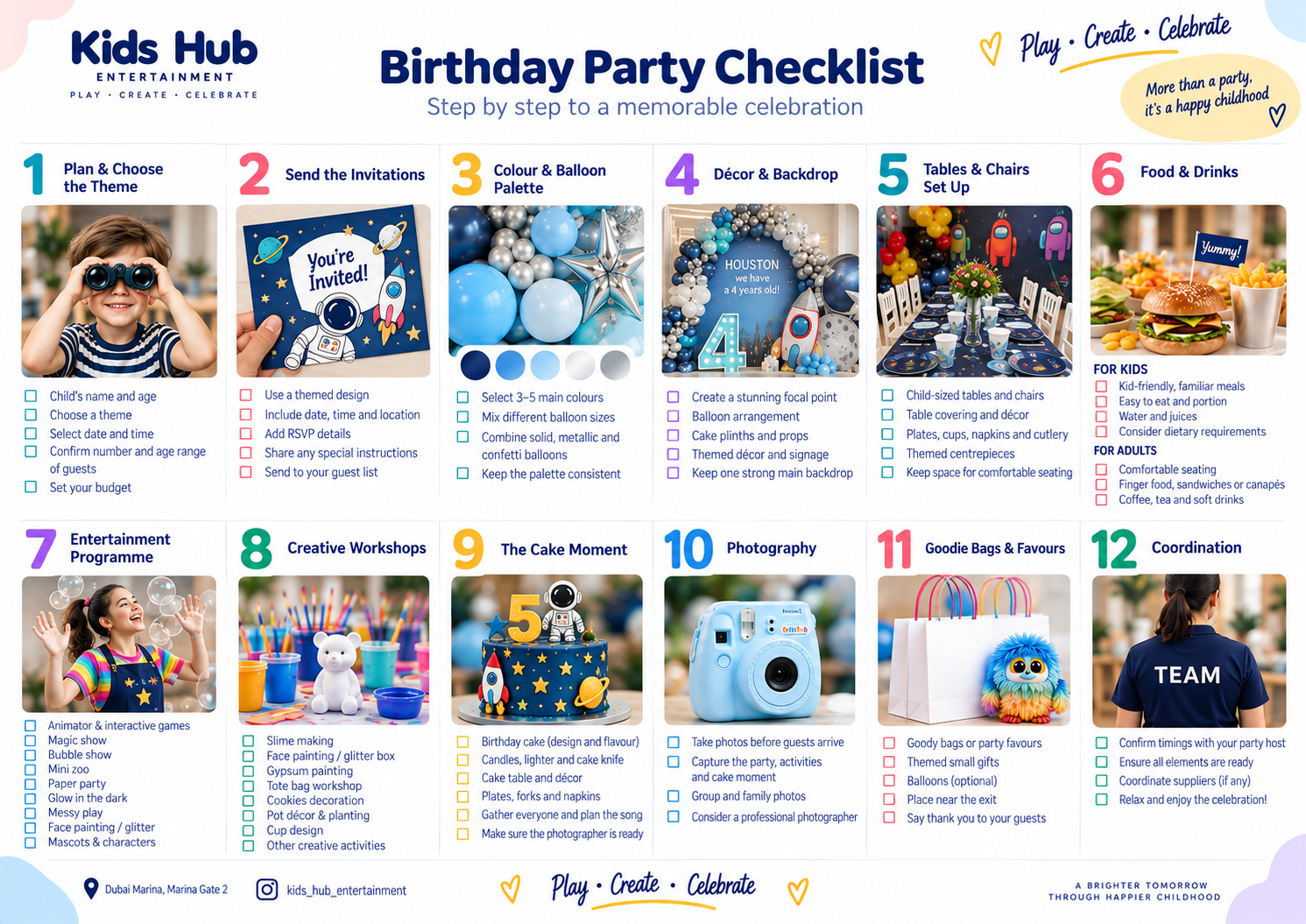
Save This: Birthday Party Checklist
Planning the celebration yourself?
We’ve put the main elements into one practical birthday party checklist so you can save it, screenshot it and keep it with you while you’re planning.
Planning a Birthday at Kids Hub?
You can absolutely use this guide to build the celebration yourself.
And if you’d rather have the venue, setup, décor, children’s tables, food, activities, entertainment and party flow brought together for you, that’s exactly what we do at Kids Hub Entertainment in Dubai Marina.
The same principles you’ve just read are the ones we use when building our own birthdays: start with the child, create one visual story and plan the experience around how children actually play.
Frequently Asked Questions
Can I choose my own birthday theme?
Yes. We build the birthday concept around the child’s age and interests, and the theme then guides the colour palette, décor and other visual elements of the celebration.
Can Kids Hub arrange the décor and balloons?
Yes. Décor and balloon arrangements can form part of the birthday setup, with the design developed around the selected theme and colour palette.
Do you provide birthday entertainment?
Yes. Birthday entertainment can include different types of experiences such as interactive games, creative activities and show programmes. The programme should be selected according to the children’s ages, interests, group size and the overall flow of the party.
How do I choose entertainment for different ages?
Start with the children’s developmental stage rather than choosing the activity purely because it looks impressive. Younger children generally benefit from shorter, sensory and movement-based experiences, while older children can usually engage with longer workshops, structured games, challenges and shows.
Should every part of the birthday match the theme?
It should feel connected, but that doesn’t mean putting the character or theme on absolutely everything. Repeating a consistent colour palette and a few carefully chosen visual elements across the invitation, balloons, backdrop and table is usually more effective than overdecorating.
Where is Kids Hub Entertainment?
Kids Hub Entertainment is located at Marina Gate 2 in Dubai Marina, Dubai.